The dream
You did everything right. You hired a designer, picked the perfect color palette, agonized over every button radius and hero image. The copywriter nailed the tone. The developer shipped it on time. Launch day felt like Christmas morning.
Friends said it looked amazing. Your team shared it on LinkedIn. You updated your business cards. And then… nothing happened.
No organic traffic. No leads from Google. Your beautifully crafted pages sitting in the void of the internet, invisible to the very systems that drive 68% of all online experiences.
The problem nobody told you about
Here is something most web designers and agencies will never mention up front: building a website and making it discoverable are two completely different disciplines. A site that looks stunning to humans can be utterly meaningless to search engines and AI systems.
Google does not browse your site the way a visitor does. It does not admire your typography or appreciate the smooth scroll animations. It crawls raw HTML, looking for structured signals that explain what your business is, what you offer, and how your pages relate to each other.
Without those signals, your site is just text noise — a wall of paragraphs that a machine cannot reliably parse into meaning.
And it gets worse. The search landscape is shifting fast. Google is building its Knowledge Graph. ChatGPT, Perplexity, and AI agents cite only sources they can understand structurally. Voice assistants answer questions — they do not list ten blue links. If your site lacks a clear entity graph, you are not just losing rankings. You are becoming invisible to the entire next generation of search.
What search engines actually need
Search engines and AI systems need structured data — a machine-readable layer that sits alongside your HTML and explicitly declares: "This page is about an Organization called X, located at Y, offering services A, B, and C." That layer is called schema markup, usually delivered as JSON-LD in your page's <head>.
But it is not just about dropping a few JSON blocks on random pages. What Google really values is a connected entity graph — pages that reference each other through @id links, forming a web of structured knowledge. Your organization connects to your services. Your services connect to FAQ answers. Your blog posts connect to authors. Like a mini Wikipedia, but for your business.
Sites that have this graph get rich results, knowledge panels, voice answers, and AI citations. Sites without it get… organic decay.
The old way: expensive, fragile, and always out of date
Traditionally, there are two options. You can hire an SEO agency to manually write and maintain schema markup across your site. This typically costs $500 to $2,000 per month, requires constant updates whenever content changes, and often results in markup that breaks silently — nobody notices until rankings drop months later.
Or you can ignore it entirely. Which is exactly what most businesses do. Not because they do not care, but because nobody told them it mattered. Your designer was focused on pixels. Your developer was focused on shipping. SEO was "someone else's job."
Both options are losing strategies.
One script. Full knowledge graph. Always current.
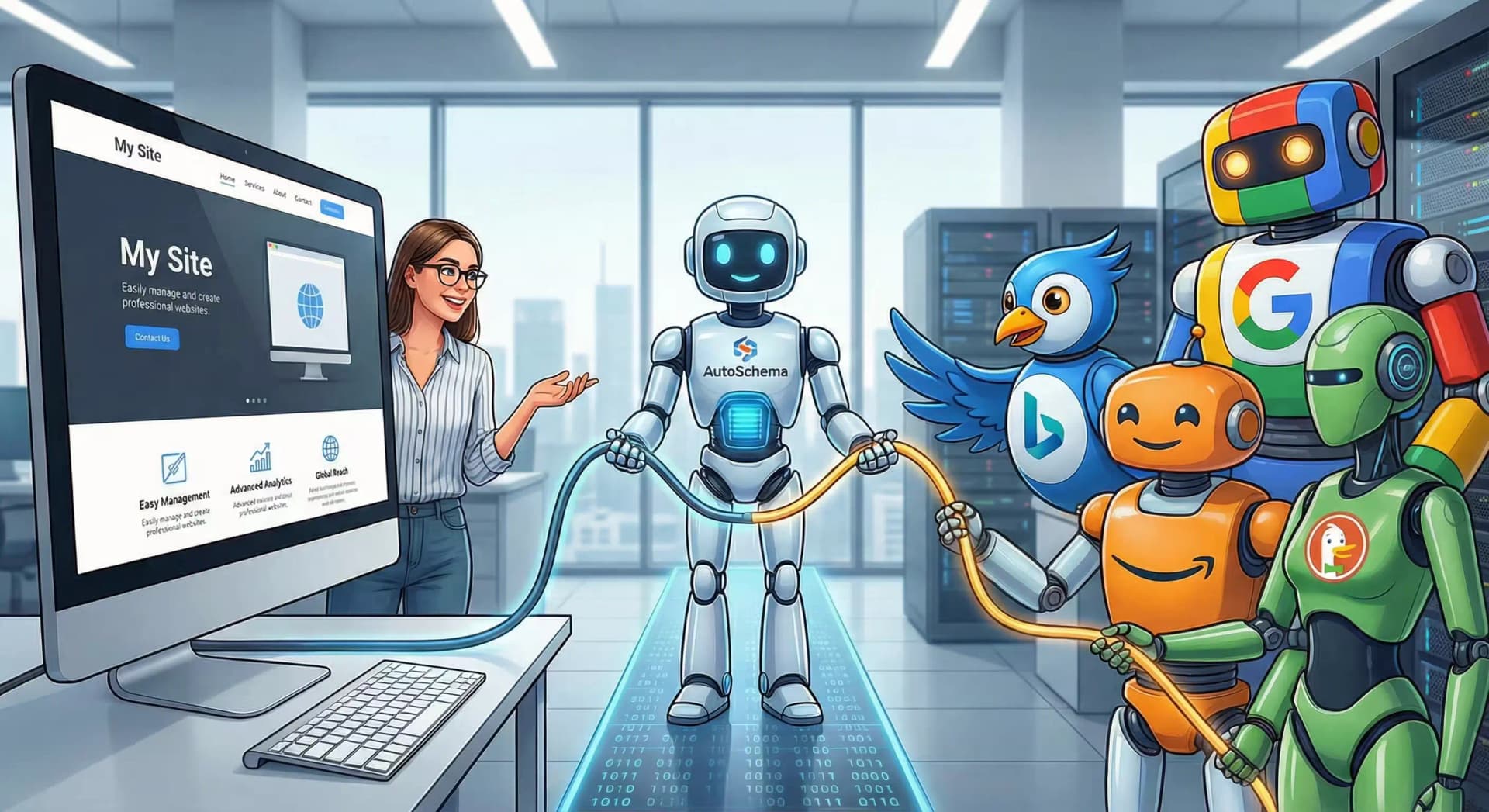
AutoSchema takes a different approach. You add a single line of code to your site's <head>:
<script src="https://autoschema.app/api/schema?key=YOUR_KEY" defer></script>That is it. Our engine scans every page, classifies its type — homepage, product, service, article, FAQ, person, event — builds a connected entity graph, and delivers the right JSON-LD to every visitor and every crawler, automatically.
No manual markup. No agency retainer. No broken schemas after a CMS update. The graph rebuilds itself as your content changes.
80% of pages are classified using deterministic rules — no AI hallucination, no invented data. AI is used only where interpretation is genuinely needed. Safe Mode guarantees: no fabricated ratings, no made-up prices, no phantom authors. Only what actually exists on your page.
Who this is for
AutoSchema is for any business where a single new customer is worth more than $19. It is for agencies that need to scale SEO across dozens of client sites without manual labor. It is for developers who want correct structured data architecture from day one, not as an afterthought.
Free plan lets you try it on one site, ten pages. Pro starts at $19/month with server-side delivery and SERP tracking. Business and Agency plans scale to hundreds of pages across multiple sites.
One question
If Google and ChatGPT looked at your site right now — would they understand who you are and what you do?
Find out in 30 seconds. Free. No signup required.
Check your site free →