A brief history of getting found
In 1998, having a website was enough. If you were online, you were ahead. A few static HTML pages, a phone number at the bottom, maybe a guest book — and customers could find you because nobody else was there.
By the mid-2000s, the bar moved. You needed a CMS — WordPress, Joomla, Drupal — so you could publish and update content without calling a developer every time. Having a website was no longer special. Having a manageable website was.
Then came the SEO era. Keywords, backlinks, meta tags, page speed, mobile-first indexing. An entire industry emerged around one obsession: ranking higher on a single page of ten blue links. Billions of dollars were spent fighting for Position 1 in Google.
Each shift felt dramatic at the time. But they all shared one assumption: if you play the game well enough, Google will send you traffic.
That assumption is now broken.
The rules changed while you were optimizing
Google is no longer just a list of links. It is an answer engine. When someone searches "best Italian restaurant near me," Google does not just show ten websites — it shows a direct answer, a map, a knowledge panel, reviews, and sometimes an AI-generated summary. The user never clicks a single link.
And Google is no longer the only player. ChatGPT answers customer questions. Perplexity summarizes research. Apple Intelligence handles voice queries. AI agents book appointments, compare products, and recommend services — all without ever visiting your homepage.
The battle for ten blue links has become a battle for being understood. Not by humans — your site already works for humans. By machines. By AI systems that parse the internet to construct answers.
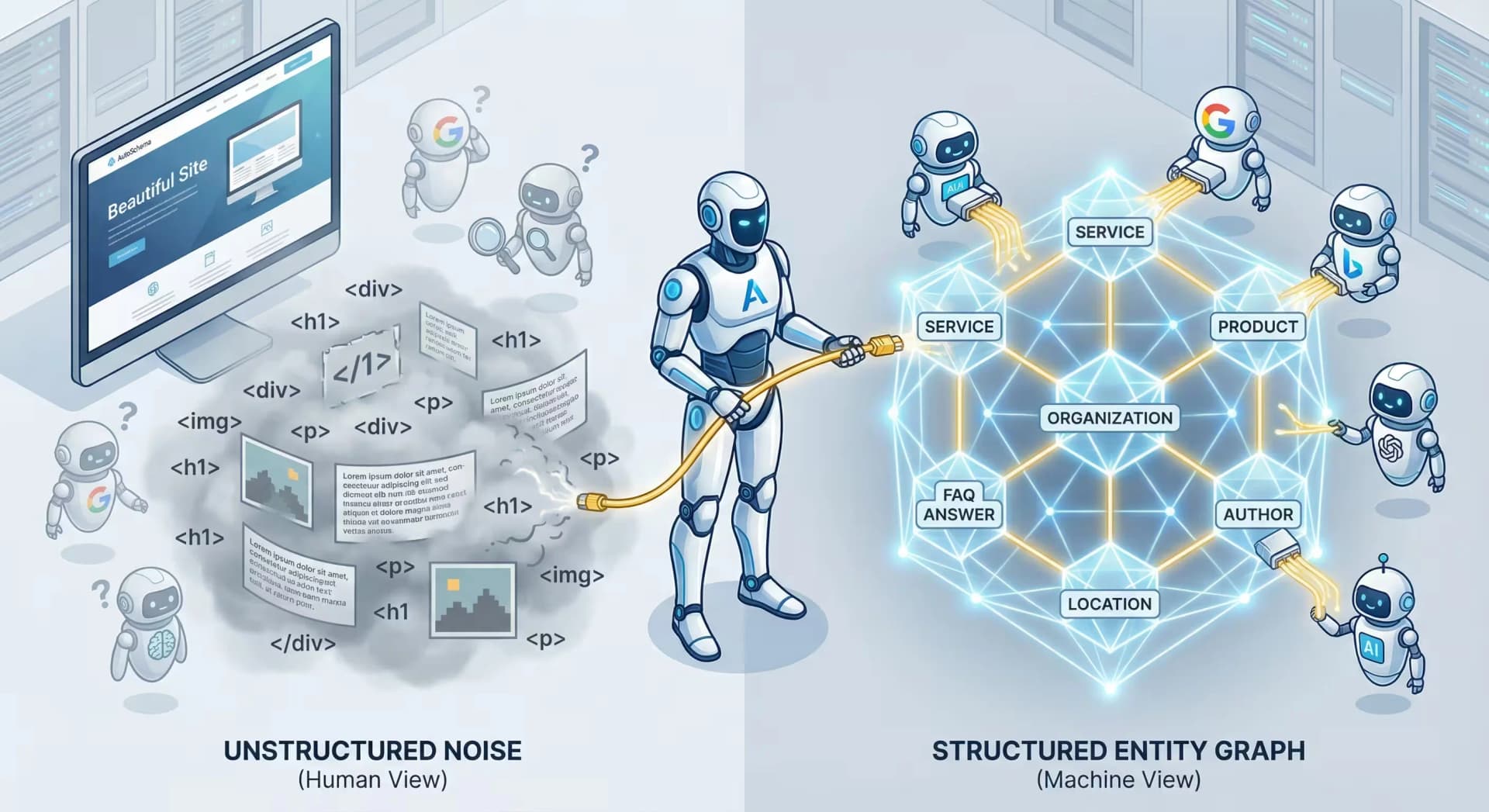
And here is the brutal truth: most websites are meaningless to these systems. Not because the content is bad, but because there is no machine-readable layer that explains what the content means.
AI reads meaning, not pages
When ChatGPT decides which plumber to recommend in Austin, Texas, it does not read your homepage like a human would. It does not admire your hero banner or scroll through your testimonials section. It looks for structured signals: entity type, service area, contact details, service descriptions, ratings — all encoded in a format it can parse instantly.
That format is schema markup — specifically, a connected knowledge graph delivered as JSON-LD. It is the difference between a pile of words and a structured database entry that an AI can query.
Without it, your site is invisible. Not to humans — to the systems that increasingly decide which humans see you at all.
Think of it this way. Traditional SEO was about convincing Google your page was relevant. Structured data is about telling every AI system exactly what you are — so it can decide, instantly, whether to recommend you.
The cost of being invisible
This is not a theoretical problem. It is happening right now. Every day, potential customers ask AI systems for recommendations. Every day, AI systems answer — and your business is not in the response. Not because you are bad at what you do, but because the AI simply does not know you exist.
The customer never Googles you. They never visit your site. They never see your beautiful design or read your compelling copy. They ask an AI, get a list of three names, pick one, and move on. You lost the customer before the competition even started.
And it compounds. AI systems learn from usage. The businesses they recommend get more engagement, which reinforces future recommendations. The ones they skip fall further behind with each passing week. It is not a slow decline — it is an accelerating one.
What to do about it
The answer is not more keywords or more backlinks. The answer is structured meaning. Your site needs a machine-readable identity: a knowledge graph that declares who you are, what you do, where you operate, and how your pages connect to each other.
AutoSchema does exactly this. You add one script tag. Our engine scans your site, classifies every page, extracts entities, and builds a connected JSON-LD knowledge graph — automatically. No manual markup, no technical expertise, no ongoing maintenance.
When your content changes, the graph updates. When Google or ChatGPT crawls your site, they find a structured, validated, connected data layer that tells them everything they need to know.
You stop being text noise. You become an entity.
The fifth era of the web
Static sites. CMS. SEO. AI-driven search. Each era made the previous strategy insufficient. The businesses that adapted early dominated. The ones that waited watched their traffic erode until it was too late to catch up.
We are now at the start of the fifth era: the structured meaning era. The winners will not be the ones with the biggest ad budget or the most backlinks. They will be the ones whose sites are understood — by every search engine, every AI assistant, every voice agent — instantly and unambiguously.
The question is not whether this shift is happening. It is whether you will adapt before your competitors do.
Where does your site stand?
Run a free scan and see exactly what AI systems understand about your business right now. It takes 30 seconds.
Scan your site free →